
Facilities
Computer Facilities
The Center maintains a Linux computational cluster used for fMRI and diffusion imaging data analysis. The cluster consists of 20 compute nodes, each with 32-40 cores, 128GB of memory, and 80TB of shared disk space, running OpenSUSE Linux, with Infiniband 20Gbps networking enabling high throughput of machine learning and image processing pipelines. We also have CUDA GPUs for parallel processing. Our Center primarily uses Matlab software (with Parallel Toolbox) for customized analyses of fMRI data and SPM for signal processing.
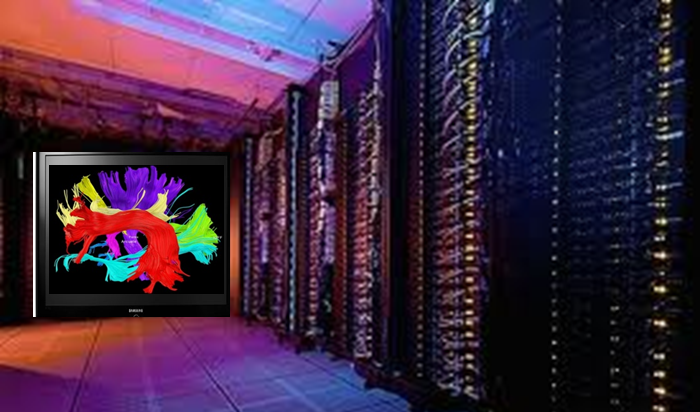
The Center also has about 20 Windows desktops, some used as remote terminals for the cluster access and for data acquisition (experiment running). They are networked in a Windows domain that also includes domain controllers and a file server. The experimental machines run the CogLab Experimental Control Program.
Additional Instrumentation
The CCBI also uses an MRI-compatible EEG apparatus in some studies that permits concurrent acquisition of EEG and fMRI data and an MRI-compatible TMS apparatus in other studies that enables applying TMS and monitoring the impact on brain functioning with fMRI.